Showing posts with label The Games of 1992. Show all posts

Tuesday, December 13, 2022

Home Alone 2: Lost In New York

Developed by Imagineering for the SNES and released in 1992 by THQ, Home Alone 2: Lost in New York adapts the film of the same name as a 2D platformer

It is disingenuous to even call most of the movie video game adaptations of the 80's and 90's "hit-and-miss." A better description would be "abysmal-and-barely-playable." Just about every video game version of Home Alone 2: Lost in New York is abysmal. Thankfully, the SNES iteration transcends the abysmal to become the merely barely playable...barely.

Hey, they kind of got the logo right!

This game attempts to adapt the film of the same name, which tells the story of an 11-year-old named Kevin. Kevin boarded the wrong flight at the airport, was separated from his family, and has to make his way through New York City alone. He first stays at the Plaza Hotel, but his dad's credit card and most of his money are taken away by an overzealous hotel manager. The SNES adaptation starts out the moment Kevin is found out at the Plaza, and the game's opening screen gives the player roughly one second to run right, jump, and grab a necklace to throw at Tim Curry's hotel manager character...or they'll die. That's right, if you don't hit a button within the first second of Home Alone 2: Lost in New York for the SNES, you're killed. By Tim Curry.

Take one more step and I'll make this necklace I picked up inexplicably fly out of my body and kill you

In the movie, Kevin grabs some necklaces, rips off some beads, and throws them on the ground so that the bad guys will slip on them. In this game, if you find a necklace, you just throw it at a bad guy (or girl) and it kills them. There are limited items spread around each level, like a stun gun, or a toilet plunger gun (a gun that shoots a boxing first...I don't know what it's supposed to be), just like in the movie, wait, not just like in the movie, and you've got to shoot the bad guys. In this game, literally every adult is a bad guy you've got to kill or stun to get past.

Watch out, trench coat perv man, I've got a toilet plunger boxing fist thing gun, and I'm not afraid to use it!!

What kind of bad guys will you face? In that first level, it's hotel employees, anthropomorphic vacuums, and mop buckets. In the next, where you're run off to a late night Central Park, it's thugs, rats, and bats. Just like in the movie...wait...not just like in the movie.

I also don't remember giant spiders or mountains of trash bags

Home Alone 2 for the SNES isn't much of an adaptation of the film. It's also not much of a video game. It only moves past the abysmal and into the barely playable category for a few reasons. The first is that the game isn't horrible looking. Your 2D Kevin actually looks like Macaulay Culkin. 2D Tim Curry actually looks like Tim Curry. The levels themselves aren't breathtaking or anything, but they at least partially evoke the world of the film, which is more than I can say for the gameplay. Meanwhile, the music broaches the sacred realm of the tolerable. Not great, not even necessarily good, but you at least won't want to tear off your ears while playing.
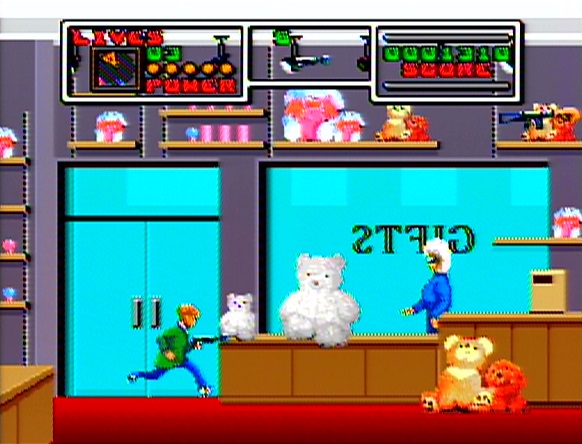
Gimme all the money, granny, or the teddy bear gets it!

As for the gameplay, Kevin's running and jumping mechanics are fine. However, enemy placement is fairly terrible, you'll often have no weapons with which to deal with them, and you'll rarely have any idea of what you're supposed to be doing. For instance, the game's first boss, the Plaza Hotel first-floor elevator, requires you to hit the up button on the elevator five times as living briefcases and I think couches dive toward you. Get up to the next floor, and you have to discern that once you get off the elevator, you've got to go down the hallway and enter and exit every room until you get to the end, then turn around, go back to the elevator, and hit the elevator button again.
 
Totally forgot there were apparently murderous chefs in the film, and now they are my favorite characters

After facing smaller minion chefs, you'll eventually get to the level boss, who is, inexplicably, a large, nearly shirtless master chef, who is only vulnerable to your slide move, utilized by quickly tapping "down" while you're walking. Get through all of that insanity, make it to Central Park, die, get a game over, and you've got to start all over...from the opening Plaza Hotel screen. This game has no passwords or continues. Thankfully, you can earn extra lives by picking up pizza slices (make a whole pizza and you get an extra life), but unthankfully, the unwieldy level design ensures you'll die very often. The game is nowhere near fun enough to warrant trying over and over again, either. It's not even fun enough to warrant trying a few times.
 
Just kill me, guys, I don't want to play anymore

Home Alone 2 for the SNES is the type of game you would have only played through because it was your only option, you had a lot of time to play, and nothing else to do. In today's world, even with astronomical inflation compared to 1992, you can choose from thousands of indie or classic games on a digital platform that cost less than ten bucks and are massively more fun than Home Alone 2. In 1992, Home Alone 2 was $70 from Toys 'R Us and probably the only game you'd have continuous access to for months if you bought or were given it. Then again, you actually owned a game back then, even if it was a piece of crap. Stalemate, 1992/2022. Either way, there had to have been a better way to adapt Home Alone 2: Lost In New York for the SNES.

Yeah, you were. Also, happy 30th Anniversary, Home Alone 2: Lost in New York!


Graphics: 6.0/10.0

Sound: 5.0/10.0

Gameplay: 3.0/10.0

Lasting Value: 2.0/10.0


Overall: 3.6/10.0


Wednesday, December 22, 2021

Batman Returns 16-Bit Showdown


Almost every major blockbuster in the early 90's received a video game adaptation. Even Domino's and Seven Up's mascots received their own video games. If the Noid got his own game, there's no way the hype machine behind Batman Returns was going to let that 1992 smash hit pass through without an adaptation...or seven. Batman Returns is a seminal film for me--at eleven years old, I fell into the film's prime demographic, and I love it to this day. With a protagonist like Batman, major villains like Penguin and Catwoman, and a clearly designed group of underlings in the red triangle circus gang, a 16-bit video game version of Batman Returns essentially designs itself. Developers just needed to put Batman on Gotham's icy streets and let him punch and kick his way through an army of circus freaks, while periodically battling with the two major foes. Toss in some Christmas trees and giant presents in the background for good measure and viola: Batman Returns game. That's just what the three 16-bit adaptations of Batman Returns do...to varying degrees of success.


Batman Returns, Sega Genesis, December 29, 1992

Sega's Malibu-developed Batman Returns game was first to market. The game is a side-scrolling action-platformer, like many movie game adaptations from the era. The speed at which the game came to market betrays Sega's "that's good enough, let's hurry up and get this thing on the shelves" approach, taken with several of their adaptations at the time. This game was clearly not play-tested enough to make sure it was actually fun, though, and...it's not very fun. The absolute first moment of the Sega Genesis Batman Returns asks the player to take a blind jump from the top of the building. You can actually die during this moment, and it's nowhere close to the only blind jump Batman Returns for the Sega Genesis makes the player take. The controls aren't great, either. You've got one button for special items, one for jumping, and one for punching/kicking. You'll also have to use the grappling hook at times (using the jump button and directional pad), but unfortunately, the grappling hook is only even fairly reliable when you're standing still, let alone trying to swing around. You've also got to solve environmental puzzles at times, often on the fly, with death often nigh. With all that in mind, this game is alarmingly difficult. However, it does not earn that difficulty. Beloved legendarily difficult games are generally beloved because the control systems for those games are tight and reliable. You aren't dying because of flaws in those games, only because of your own lack of skill. Batman Returns for Sega Genesis is not that type of game--it is balls out hard because it is not very good. As for production values, the menu screens and pause screen (where you select what special, limited ammo weapon you want to use, i.e. batarang, etc.) look fine. The actual, in-game graphics are kind of simplistic, but solid. The graphics are certainly a step above 8-bit, but nothing great. Same for the music--you've got that trademark, bass-reliant Genesis sound, but nothing much memorable. I will say, though, that the game does capture a bit of the film's dark, inkwell atmosphere...it just doesn't do very many fun or satisfying things with it. Like most Genesis games, there's no save system (or password system). You can continue when you get a game over, but you have to start all the way at the beginning of that particular stage. Each stage has multiple levels, so if you get a game over during the final (generally unfair) boss on the final level of the stage, get ready to play through the entire stage again...not very fun. A disappointment.

Graphics: 6.0/10
Sound: 6.0/10
Gameplay: 4.5/10
Lasting Value 4.0/10
Overall (Not an Average): 4.8/10.0


Batman Returns, Super Nintendo, April 1993

Storied developing house, Konami, took the reins for the Super Nintendo adaptation of Batman Returns. Konami decided to take their adaptation down the 2D beat 'em up route, ala Streets of Rage and Final Fight. This decision, along with Konami's skill as a developer, and perhaps the extra four months Konami spent on this versus Malibu's Genesis version, results in a pretty special game. In opposition to the Genesis adaptation, the controls here are tight and reliable. Tap a button to punch, tap it rapidly to combo and kick. There's a button to jump. Hit jump again to use the grappling hook--reliably. There's a button to throw the batarang, which does minimal damage, but very briefly stuns foes. There's devastating cowl twist move done by holding two buttons that takes a little health off Batman's meter if it connects. There's even the classic beat 'em up "kill everyone on screen" special item. In some games, that item, which you only get so many of, is utilized by just pushing one button, resulting in the player often accidentally unleashing it. Konami solves that problem by having the player hold down the shoulder buttons (which also cause Batman to block), then push another button--a simple solution that helps the player avoid accidentally using the attack. Of course, with side-scrolling 2D beat 'em ups, the player can move up and down in the field of play, as well as left and right. There are no control issues there. However, this game doesn't just stick to the basics. There are bunch of cool little touches. Of course, if you get close to an enemy, you'll grab them and can slam them into the ground or other enemies, but here, if two enemies approach you from opposite sides at the same moment, you can grab them simultaneously and bash their heads together. If you grab an enemy and are standing near a window, you can slam them into it and shatter it--same goes for park benches or other breakable surfaces. Each level has a boss from the film at the end, including that organ-grinder with a monkey and a machine gun. There's even an awesome Mode 7 (faux 3D, scaling sprite) Batmobile stage that looks and plays great. The graphics as a whole here are beautiful, highly detailed, with large, well-animated sprites, and great backgrounds, and it all runs smoothly with no slowdown. The music is mainly 16-bit interpretations of the score from the film, and it sounds great. The Sega Genesis version doesn't have anything like that. This Super Nintendo adaptation simply crushes the Genesis one in both production value and gameplay. That's not to say it's perfect, though. Sometimes the action does grow a little stale. You'll be in the same area wanting to move on, and enemies will just keep flooding in. The length is also at that awkward 45-60 minute mark, where there are no passwords or saves available, and you've simply got to dedicate that big of a chunk, minimum, to get through. You can toggle the difficulty level and number of lives available from the option screen, and each difficulty level feels well-balanced and appropriate. The more I played, the better I got--Catwoman kicked my butt the first few encounters, but after a number of showdowns, I was wiping the floor with her. Overall, Batman Returns for the Super Nintendo isn't just a good adaptation of the film, but one of the better film adaptations of the 16-bit era.

Graphics: 8.5/10
Sound: 8.0/10
Gameplay: 8.0/10
Lasting Value: 7.8/10
Overall (Not an Average): 8.0/10.0


Batman Returns, Sega CD, May 1993

The 1993 Sega CD port of the Genesis' Batman Returns game proved to be the film's final 16-bit adaptation. Sega CD ports of Genesis games were often derided for simply being the same game with a slapped on Redbook soundtrack. Malibu's Batman Returns port received some attention for essentially being that, while adding an entirely new element: sprite-scaling, faux 3D driving. The levels and controls are exactly the same as the Genesis game, but now there are driving levels between each stage. These play and look similarly to the Super Nintendo driving stage, except the controls aren't as good. You've got to hold down the B-button, while pushing the A button to fire discs out, and press C to fire missiles, while using the directional pad for horizontal direction/to ram into foes. The driving stages are timed, and failing to destroy all enemies before the timer runs out results in death, so you've got to constantly hold down the accelerator while firing...meaning you've got to put your hands into some arthritis-inviting positions. I did not enjoy this aspect of the game. It's remarkable that Konami nailed the single driving segment in their game, which could have just been a throwaway stage, but Malibu made driving half of their game, and it doesn't quite work. The driving stages here don't even look as good as the one in the SNES game. The Sega CD Batman Returns' updated soundtrack, while of a much higher sample quality than the other two 16-bit adaptations, only consists of a few pieces recycled over and over again throughout the game, which are seldom interesting. The game's graphics as a whole, though, do look a little bit sharper than they did on the Genesis, but unfortunately, the gameplay is exactly the same--not fun. But hey, there are some new animated cutscenes that look...adequate. Overall, this Sega CD version of Batman Returns is only marginally better than the Genesis one. The driving stages are tedious, and when added to the already tedious action-platforming, just make the game even more tedious. Beating this game in one sitting--which is the only way to beat it since you can't save or use passwords--will take so long, you'll need the patience of a saint, and the masochist nature of a Cleveland Browns fan. This should have been so much better.

Graphics: 6.2/10
Sound: 6.0/10
Gameplay: 4.8/10
Lasting Value: 4.2/10
Overall (Not an Average): 5.2/10.0


I did one of these showdowns for Jurassic Park a while ago and have to admit, I had a bit more fun doing that one because 2/3 of the games weren't awful. Batman Returns for the Super Nintendo is the only 16-bit adaptation of that film that's worth playing. The other two have attractive boxes and that's about it. An objective ranking here is easy, with far more distance between one and two than there is two and three.
Merry Christmas, and goodwill toward men...and women.

1. Batman Returns (Super Nintendo, 1993)
2. Batman Returns (Sega CD, 1993)
3. Batman Returns (Sega Genesis, 1992)

Friday, September 3, 2021

Hook

Released for the Super Nintendo in 1992 by Sony Imagesoft, and developed by Ukiyotei, Hook is a side-scrolling, action-platforming adaptation of the 1991 Spielberg film of the same name.
Love it or hate it, Steven Spielberg's 1991 Peter Pan as an adult children's film, Hook, sure produced a lot of video game adaptations. Most SNES and Sega Genesis movie adaptations followed the same basic formula: Movie protagonist + 2D stages based on whatever was in the movie + jumping and hitting things = profit.
This formula resulted in a large number of sub-par action-platformers, with just a few diamonds in the rough. Does the SNES 1992 action-platformer, Hook, featuring a flying, knife-wielding Peter Pan shine, or is it as dull as the titular Captain's black heart?
 
The graphics department at Tri-Star didn't go through all the trouble of designing this logo for it to NOT be on 10,000 different things, including a SNES game
One thing stands out immediately once you boot this buccaneer up: the production values are through the roof. You're immediately greeted by long, animated cutscenes, detailing the plot of the movie, and high-quality 16-bit recreations of John Williams' film score. This game is no cheap, throwaway adaptation. Once you jump into the gameplay, the production values feel even higher. The graphics, featuring highly detailed, beautifully drawn, sometimes animated backgrounds, and highly detailed, well-animated character models, are excellent. I may look more like Robin Williams than the Peter Pan in this game, but he and his wind-billowing cloak look great, as do all of Pan's varied, but mostly pirate enemies, as they strut around in a charmingly realistic, great for SNES manner.
 
Wait...are you Spiderman?
As stated, the music here is another high point, with the legendary John Williams done justice by the SNES' nearly just as legendary sound chip. The same pieces aren't just repeated ad nauseum, either. There are a lot of different songs featured here. The sound effects aren't the best, but they get the job done. Overall, the music and aesthetics of this game create a pretty stunning package--which makes the sluggish gameplay all the more disappointing.
 
Nothing like stabbing some children to get the blood flowing
When I think Peter Pan, I usually think of a fast, agile, and highly maneuverable character. However, I guess the developers here were thinking more the peanut butter brand, because Pan moves around in this game like he's wading through a jar of the stuff. Peter walks SLOWLY and you can't make him run. It feels like it takes forever to get Pan from one side of the screen to the next. Get under some fairy dust at select moments of the game, and you can fill up a meter that lets you fly for a limited amount of time--SLOWLY. Fall in some water. No problem. You can swim--SLOWLY.
 
The good thing is, most of your enemies, including the bosses, also move pretty slowly. Maybe I should have put "good thing" in quotes.
The controls here are pretty responsive (you're just moving/jumping around and swinging your dagger at stuff, and sometimes swimming/flying), but the slowness takes a lot out fund out of the game, and makes certain sections of Hook needlessly difficult. Add in what seems to be a hitbox that stretches a foot or so past Pan's body, and you've got a recipe for frustration. There are some cool ideas here, like hidden leaves that add to your limited life meter, a power-up that lets your dagger shoot beams of light, and a handful of level-ending boss fights (there's a boss at the end of just about every other level), but the slow movement speed just crushes everything. Maybe, with all of the graphical excellence onscreen, the developers couldn't get Pan moving any faster. Movement isn't the only frustrating element here, either.

Little shop...little shop of horrors...
Hook features 12 moderately long levels that become marathons because of Pan's slow movement speed. That would be mitigated if there was some type of saving or password system, or even a level select cheat, but there's nothing of the sort here. While you do get unlimited continues, dying always starts you back at the beginning of a level, unless you've reached the boss (and continuing means you've got to start at the beginning, regardless). This means, especially considering the game's difficulty, that you're going to have to spend hours upon hours getting to the end of this thing. And considering the slow movement saps a lot of the fun away anyway, those aren't hours you're likely going to want to waste here.

Graphics: 9.0/10.0

Sound: 8.0/10.0

Gameplay: 5.0/10.0

Lasting Value: 5.0/10.0


Overall: 5.8/10.0


Wednesday, March 18, 2020

The Legend of Zelda: A Link to the Past

Released on April 1, 1992 for the Super Nintendo by Nintendo, and developed by Nintendo EAD, The Legend of Zelda: A Link to the Past returns the action-RPG series to a top-down view for Link's first and only 16-bit adventure

I bought an SNES because I wanted to play Street Fighter II at my house. Kick stupid Guile in the face with Ryu from the comfort of my den? What could be better? In January of 1995, Blockbuster had a used copy of Super Street Fighter II for $5. That's like the same price as a rental! Add to that,  Wal-Mart was selling an SNES for $100! I'd just pooled my Christmas cash (some from returning gifts), and I had $120, enough to get both, pay the taxes, AND get this sweet book about how to draw boats that I saw at the art store.

There's a great diagram for a shrimp boat in here

I had an okay time with Super Street Fighter II. It's a good game. However, after a few days playing it, I felt strangely empty. My cousin, Adrian, came over one day, and seemed to notice I was getting tired of it.
"You should try the game that came with the Super Nintendo," he said. "That Zelda one."
"Zelda games are lame," I said, having never played a Zelda game in my life.
I had just turned 13 at the time, and was at the tail end of a period of personal funk--that time in life where I was tired of being treated like a kid, and only having access to things I'd felt I'd outgrown years before. My NES had started to grow extremely stale, but for some reason until then, upgrading to the SNES never occurred to me. Everything just felt old and boring, and to top it off, I was late blooming, still with my little kid voice and hairless armpits. Everything sucked! My grandfather died on Friday the 13th, January of 1995, and considering, out of 13 grandchildren, I was his only namesake, I just felt done. Life was a giant suck sandwich.

Just warp me to the Dark World already

However, something about the SNES made me hopeful. Finally, something new...but my close-minded nature was stopping it from actually providing a new experience. I just wanted to play a game I'd already spent hours upon hours with in the arcade. Or did I? Obviously, SFII was already played out for me. After wrestling with Adrian's words for days (new stuff, amIrite, INFJ's?!), I finally pulled The Legend of Zelda: A Link to the Past out of the Super Nintendo box, ejected Super Street Fighter II from my SNES for what I assumed would be a short while, and put A Link to the Past in its place. The rest is history.

Game Over to my pre-Zelda life

My little brother just happened to be in the room when the immersive opening screen and cinema of A Link to the Past started to roll, as by that point he'd forgiven me for drawing a (phenomenal) picture of his future shrimp boat getting attacked by a giant squid. Both of us sat transfixed through the title screen, the opening cinematic, and the incredible opening sequence, where young Link (or whatever you end up calling him--it's your choice when the game beings) is visited by the titular Princess Zelda in a dream. She asks for Link's help, before Link is suddenly awakened by his Uncle, who's headed off into a rainstorm to rescue the very Princess Zelda from Link's dream. At this point, you take control of Link, and run out of the house into the glorious weather effects of a 16-bit storm, find a path to the castle, and discover your uncle has been incapacitated. The old man gives you his sword and his mission, and your adventure begins.
 
Any 16-bit game that's lets you climb a high precipice and view the land below is great in my book

The Legend of Zelda: A Link to the Past immediately sucks the player in with its production values and atmosphere, but keeps them transfixed with its incredible gameplay. I immediately connected on a tactile level with the ease and way I could move Link around in the spaces of the game's overhead perspective. The controls felt more spot on than anything since the first Super Mario Bros. game I'd played years before. And now, as I play through this game again 25 years later, the controls still feel so spot on. The session for this review is the fourth time I've completely played through A Link to the Past. Every time has felt revelatory.

*Sigh* This view...

Link's movement is controlled with the D-Pad. There's a button assigned to his sword, one for using an item (whichever one the player has selected, i.e. the bow and arrow or lamp), one to perform a dash (once that move is acquired), and one to access the map. The start button brings up Link's vast inventory. The select button brings up save and quit options. It's a perfect scheme, perfectly executed. Good luck playing through this game, and then not expecting the buttons to map the same in whatever subsequent 1top-down action-RPG you play. They should all be like this.

Home sweet home...until this bird swoops me away

Once Link rescues Zelda in the game's opening sequence, he's off to numerous dungeons to collect magical amulets, to help fight against the evil wizard who's kidnapping all of Hyrule's maidens--Hyrule of course being the fantastical, medieval styled land of mountains, forests, lakes, and rivers in which Link resides and traverses. Hyrule's dungeons, sprinkled liberally throughout the land, are a pinnacle of 2D game design. They're tough, yet their layouts are extremely logical, the work of game designers at the peak of their powers. All dungeons follow the same basic blueprint: fight through numerous, enemy-filled rooms, solve an extremely diverse assortment of puzzles, and collect keys to  pass through locked doors to progress.

Hmm, I really want that treasure, but I also really don't want to fall into a bottomless pit

Each dungeon also contains a helpful map and compass, and a master key or "big key," which must be obtained to progress through each respective dungeon's final rooms, in order to access each's boss lair. Each dungeon also contains a new item for Link's inventory (i.e. a hookshot or fire rod), many of which Link needs to progress further through that dungeon, and which often give access to previously inaccessible areas of Hyrule.

Yay! Now I can access this belligerent fish creature!

Yes, it's the timeless gaming concept Nintendo perfected on the Super Nintendo, with games like this and Super Metroid: explore at your leisure, note spots that feel like places you could get to if you had the right item; eventually collect that item through your adventures, then come back to that spot with your new item. For example: 1. The other side of that broken bridge has a beam I think I could shoot a hook shot into. 2. Woah, cool, this dungeon's treasure is a hookshot. 3. Yes, when I shot my new hookshot into that beam, I got over that previously uncrossable ravine. Now I've got an entirely new area to explore! While the term "Metroidvania" would be coined after Castlevania: Symphony of the Night began to incorporate this same type of gameplay into the Castlevania franchise, in truth, Zelda games had also been doing this right here in 1992 (of course the '86 original The Legend of Zelda did something similar, but with far less structure).

Must. Go. Everywhere.

The incredible sense of discovery lent by this style of gameplay is tough to beat. During your 20+ hour journey, you'll want to get into every nook and hollow of A Link to the Past's world. You'll want to find every piece of heart, not just to extend your life meter, but because you'll simply want to find them. Just seeing what's beyond the next dungeon door is exciting. With double-digit dungeons, a full adventure awaits. And with double-digit dungeons come a huge variety of bosses, a veritable rogue's gallery of nasty beasts who are just as fun to fight as they are to simply experience. Feelings of invention and originality permeate every moment of A Link to the Past, even though it's been aped by numerous games, including Legend of Zelda ones, ever since.

Vega? I thought I was done with Street Fighter II!

Composer, Koji Kondo, is also at the top of his game here, producing some of his most memorable, atmospheric, transportive musical compositions, all appearing at the perfect times. The sound effects are also heavenly, with the sound your sword makes when it hits a boss particularly satisfying. The graphics, even going down to each dungeon's color schemes, are iconic and beautiful. The production value is off the charts--check the game's ending, which brings a satisfying and cathartic resolution to every character you've met in Hyrule's story. Oh, yes, of course, the characters--Hyrule is full of charming non-player characters, as well. Many of them have interesting stories that Link can make himself a part of, as he solves people's problems all over Hyrule. This game features so much goodness it's almost unbelievable.

This ending didn't have to tell me what happened to Flute Boy, but it is all the better for it!

If you want to nitpick, yes, when a lot is happening onscreen, like in many Super Nintendo games, A Link to the Past has some graphical slowdown. Does the slowdown affect gameplay? No. It's actually kind of charming. Everything about this game is.

Yes!!! This fight is so awesome.

Maybe I'm a little biased, though. A Link to the Past had a magical impact on my life. It lifted me out of my preteen funk--immediately after playing it, I experienced a seemingly endless wonderful wave of new things: more Super Nintendo games, a rediscovery of the original Star Wars trilogy, new friends, my dad bought us a Go Cart, we found a white kitten with mystical powers in our yard who became the best pet I've ever had, I painted my room blue, I got a TV in my room and a bigger bed and a sweet new aquarium, I grew a hair in one of my armpits. Just on and on and on and on awesomeness. Most importantly, though, from that moment in my life on, I opened myself to new experiences. Hey, variety is the spice of life, right? But I try not to forget any of the great old experiences I've had either. It helps that playing through The Legend of Zelda: A Link to the Past now is just as invigorating as it was 25 years ago.


Graphics: 9.0/10.0

Sound: 10.0/10.0

Gameplay: 10.0/10.0

Lasting Value: 9.0/10.0


Overall: 10.0/10.0