Saturday, January 31, 2026

Chrono Trigger

Chrono Trigger 1995 SNES Review Boxart
Developed and released on March 11, 1995 by SquareSoft, Chrono Trigger features timeless, unrivaled RPG gameplay for the Super Nintendo

I sold my Super Nintendo and all my games for a Nintendo 64 in 1997. I love Nintendo 64, but a couple years later, I was badly missing Super Nintendo--it's the greatest console in the history of video games, so of course I was missing it. In 1999, the greatest year in human existence, I discovered console emulation on my computer. I played NES and Game Boy games (I have since refurbished those old consoles of mine), but more than anything, I played SNES games. At some point I remembered liking Super Mario RPG a lot. I figured I should try out another RPG. For some reason, I settled on 1995's Chrono Trigger...and my life has never been the same. The game consistently blew my mind, culminating in a winning fight against the final boss in the game's apocalyptic 1999 setting literally minutes before the clock struck midnight on the millennium, on 12/31/99. I felt like I had just saved the world (hey, Y2K didn't happen!) and beaten the greatest video game ever made. I soon wondered if I would ever play a better game. The next year, I got a new Super Nintendo (I've never sold another console again) and my own physical copy of Chrono Trigger. I've played through it several times since then, but last year, for the game's 30th anniversary and for the first time in a while, a play through felt necessary.

Chrono Trigger 1995 SNES Review Lavos Lair Final Boss
Ladies and gentlemen, let's go back to the beginning

Chrono Trigger 1995 SNES Review Title Screen Square
That's more like it

I'll be frank. Chrono Trigger is still the greatest game ever made. I've played hundreds if not thousands of video games since I first played through Chrono Trigger. Some of them, like Metroid Prime, Resident Evil IV, or Hollow Knight, were so good, I still think about them all the time. Chrono Trigger is better than all of them. Objectively, the only two games in my lifetime that come close are 1991's The Legend of Zelda: A Link to the Past and 1998's The Legend of Zelda: Ocarina of Time. Maybe Ocarina of Time is a Hyrulian hair's width better. But Chrono Trigger is my favorite. Everything about this game is perfect. So perfect it's pointless for me to ramble on about it, so I'll be concise.
 
Chrono Trigger 1995 SNES Review Crono Fights a tank prison
Like Crono versus a tank

Japanese manga artist, Akira Toriyama, designed the characters for Chrono Trigger. Is that good? Toriyama famously designed the characters for Dragon Ball, in addition to countless others. Rest in peace Toriyama. It simply doesn't get any better. Every single character in Chrono Trigger has an iconic design. The main creative team assembled to create Chrono Trigger, including Toriyama, was called the "Dream Team" because of the superhuman collection of talent involved. The term was originally coined for the 1992 USA Olympic Basketball team, which was the greatest collection of professional basketball players ever assembled, and included Michael Jordan. They won every game by an average of 44 points. Chrono Trigger is the video game equivalent of beating every other team by an average of 44 points. 

Chrono Trigger 1995 SNES Review Chrono Trigger Dream Team
I guess Christian Laettner is Magus

Chrono Trigger's iconic characters are animated in a way I can only describe as perfect--Crono's double-swing sword animation might be the greatest, most fist-pumping video game animation ever created. In addition to the characters, environments and magic attacks are archetypal, as in THEY ARE the archetype. There are graphical elements I love to see in a Super Nintendo game here, done as  well as they ever were. One is waterfalls. Chrono Trigger features several, and they are immaculate--some even contain prismatic rainbows. The second is the background when the player has reached a high place. Chrono Trigger features several of these. One, containing many far off mountains, shrouded in mist, is so atmospheric, it has stuck with and stimulated my imagination ever since I first laid eyes on it. Everything runs smoothly. This might be the best looking game on the console.

 
Chrono Trigger 1995 SNES Review Denadaro Mountains Misty Mountains View Spot
The mountains
Chrono Trigger 1995 SNES Review Ocean View Cape 12,000 BC
The sea
Chrono Trigger 1995 SNES Review Denadaro Mountains Waterfalls
The waterfalls. Hey, wake up!
Chrono Trigger 1995 SNES Review Rain Storm Hunting Grounds 65 million BC 65,000,000 BC
The rain. The brooding.
Chrono Trigger 1995 SNES Review Hunting Grounds Chrono Marle Magus
The jungles. Jungles are an underrated element in the Super Nintendo's arsenal.

Yasunori Mitsuda and Nobuo Uematsu are generally considered two of the greatest video game soundtrack composers of all time. They composed the soundtrack for Chrono Trigger together. The music here is beautiful, atmospheric, iconic, endlessly memorable. The game's sound design, from every sword shink to fiery magic attack, coupled with the music, is perfect. It doesn't get any better than this. Mitsuda's work on 1999's Chrono Cross, the Chrono Trigger sequel, is the only thing that comes close. This soundtrack is the video game equivalent to John Williams' score for the Original Star Wars trilogy. Chrono Trigger's ending theme is the greatest music ever composed for a video game.
 
Chrono Trigger 1995 SNES Review End of Time Party Members Victorian Gaslamp
Once you've been to The End of Time, it is almost impossible to see this image without hearing it. Also, The End of Time, replete with bowler hat-wearing wise man leaning against a Victorian Gaslamp, is the coolest, most comforting location in a video game, ever.

At the time of its release, some critics accused Chrono Trigger of containing too simplistic of a story. I was then greatly confused when I played the game and experienced an incredible, timeless story. I soon realized that those complaining wanted a convoluted, overly dense story that would confuse and bore the average person. There are plenty of RPG's with stories like that, and thankfully, Chrono Trigger is not one of them. The tale begins simply enough. A brave, noble, yet quiet teenager, Crono, meets his inventor friend, Lucca, at the town's Millennial Fair (it is 1000 AD). They accidentally stumble onto time travel, along with the Kingdom's princess, who has visited the fair in disguise so she won't be recognized. From there, the trio accidentally discover that a malignant alien being destroys most of the Earth 1000 years later, and they resolve to stop it. During their time-travelling journey, they make new allies and enemies. The story grows more complex, shocks, surprises, but is never convoluted or confusing. It's awesome. There are HUGE, brave, shocking twists and turns in the story that few if any games have attempted before or since. The plot becomes surprisingly heartfelt. Crono, as the virtuous, but silent protagonist, is the kind of everyman with which any player that's not a sociopath can easily identify. The game's eventual seven party members, many from different time periods, each have their own fully fleshed out story, and all of those stories are awesome. This game is so awesome.
 
Chrono Trigger 1995 SNES Review Party Member Screen Who'll You Replace? Crono Marle Frog Lucca Robo Ayla Magus
I like every possible Chrono Trigger party combination and switch it up throughout the game, but out of sentimentality's sake, I beat the final boss with Crono, Marle, and Lucca this time

Of course, when it comes to video games, even the story is an aesthetic matter. How does the game play? Have you been reading the review up to this point? Perfectly! In the 90s, across the NES, SNES, and PS1, SquareSoft were known as the masters of the RPG, and Chrono Trigger is their masterwork. RPG's leading up to (and many after) Chrono Trigger feature something called "random battles," where the player will be traversing the game world, visually free of enemies, and after every few seconds of moving around, will suddenly be pulled into a battle screen where enemies must be fought. It's tough to enjoy exploration when you don't know whether or not a game is going to suddenly thrust you into battle at any moment, without any warning. Chrono Trigger eliminates this by featuring its enemies onscreen, so that the player can see them before initiating a battle. This not only greatly increases Chrono Trigger's immersion factor, but makes journeying throughout the game more fun.
 
Chrono Trigger 1995 SNES Review Crono's House World Map 1,000 AD
Also, the world map is battle free!

As to the game's battles, they are fine-tuned to perfection. At first, each character has their normal physical attack with their weapon, and better weapons are found throughout the game. Eventually, special moves, and later, elemental magic is learned by most characters. Like in most RPG's, winning fights brings experience points that go toward leveling up character stats. However, characters who fight together in Chrono Trigger also gain a special kind of experience point that eventually goes toward that duo or trio learning combos together. There are dual combos, and late in the game, devastating triple combos that are incredibly fun to earn, and these incentivize using different character combinations.
 
Chrono Trigger 1995 SNES Review Delta Force Crono Marle Lucca Triple Tech
Uh...maybe a triple tech was overkill here

Fights even transcend turn-based to a degree, as each character has a meter that must filled before an attack is possible. Different armors and accessories, as well as pickups found throughout Chrono Trigger's world can not only block enemy-inflicted status ailments, but increase the speed at which a character's meter fills. Max out a character's speed, and that given character will be getting in multiple hits to an enemy's one. The game also features many boss battles. These epic fights are strategic, as sometimes physical or magical attacks don't work on that particular enemy, or the boss may be more susceptible to a given move. Even the combination of characters used at a given time can be strategic. Just tapping buttons in this game's highly satisfying boss battles will not work. Thankfully, due to the elimination of random battles, even fighting low level enemies remains fun, and the game, unlike many RPG's, does not force grinding to increase playtime. Plus, the awesome soundtrack is backing all of it. Chrono Trigger is a perfect 25-30 hour adventure without tedious, repetitious fights.
 
Chrono Trigger 1995 SNES Review 2300 AD World Map Epoch
This is what the REAL WORLD would look like right now if I hadn't beaten Chrono Trigger before the clock struck midnight on 12/31/99
Chrono Trigger 1995 SNES Review Crater Meat Eater 2300 AD
I should also mention, I was scared Y2K would happen and take out technology before I beat Chrono Trigger! I was literally working against the clock!

There is also plenty of extra content here. The world is large, and the player gets to explore it through many time periods. At a certain point, the player can set the party to any chosen three character configuration out of the seven party members at any moment (outside of the middle of the fight). Late in the game, travelling through space and time becomes much easier for a very awesome reason. There are also tons of discoverable items that make defeating the game's final boss easier. These items require the player to take on the game's numerous, yet not overwhelming side quests. There's so much fun to be had here, and when the game is beaten, the player unlocks the revolutionary "New Game +" mode, where the player can venture back through the game from the start with the character levels and much (but not all) of the weapons and armor with which the game was ended. While the game's actual final ending is as satisfying as it gets, Chrono Trigger features a dozen unlockable endings for the New Game + player who tackles the final boss at different points in the game (that boss is nearly always accessible!). There's the perfect amount of extra content here to add to an already perfect game. 
I've got nothing else to say. Video games simply do not get better than Chrono Trigger for the SNES. 
If you haven't yet played it, now's the time!
 
Chrono Trigger 1995 SNES Review Time Travel Screen
You don't even have to time travel! Just play it somehow!


Graphics: 10.0/10.0

Sound: 10.0/10.0

Gameplay: 10.0/10.0

Lasting Value: 10.0/10.0


Overall: 10.0/10.0


Tuesday, November 25, 2025

Breath of Fire

Breath of Fire 1994 Review Box Art SNES Super Nintendo RPG Capcom Square Soft
Released in North America on August 10, 1994 and translated by Square Soft, and developed by Capcom,  Breath of Fire fears traditional JRPG action

I spent much of my early 00s college video gaming on the SNES, rediscovering my love for the system with a Dreamcast and a GameCube sometimes gathering dust on my shelf, and PS2 tearing up the sales chart. A good friend saw this and gave me a stack of his SNES games from storage, one of which was 1994's Breath of Fire, his name written on the cartridge in magic marker. I don't know why, but I kept that cartridge in a drawer for over 20 years and randomly decided to suddenly pull it out and play through the game in its entirety, just a couple of months ago. Should I have just kept Breath of Fire in the drawer?

Breath of Fire Title Screen SNES Capcom Square Soft RPG
Font of Fire

Some 90's RPG's have simple storylines, but many do not, and Breath of Fire falls in the latter category. In fact, it's probably easier if I just quote the back of the box: In a distant land, peace was maintained for thousands of years by a fearful dragon clan who could transform into powerful monsters. One day they discovered a goddess who could fulfill their every wish. Greed split the clan into dark and light dragons, each battling the other to win her magic. One member of the light dragons, along with seven of his companions, emerged to keep the opposing forces from destroying the world. Using six magical keys, they sealed the goddess into another realm. Centuries have passed. The dark dragons are destroying the land in search of the keys. When they find the keys, they will once again release the magic goddess. Light Dragon -- the time has come to draw your sword and fight for the future of your people

Breath of Fire Capcom SNES Square Soft RPG Opening Crawl
Uh...I don't know?

Breath of Fire Capcom SNES Square Soft RPG Opening Crawl People Live and Die
Deep thoughts, brought to you by Capcom and Square Soft

Obviously, you, the player, are that Light Dragon, Ryu. You've got to travel around the world, according to the above plot, while encountering, what do you know(!) seven companions from the land's diverse races of animal-like people, forming a party as you engage in turn-based battles to proceed through the plot and level up your characters. And what I found, early on, that holds true throughout the game, is that just about every aspect of Breath of Fire is very good.

Breath of Fire Capcom SNES Square Soft RPG Cliffside
Look, a very good view!

The graphics aren't quite elite, but the game looks great. The sprite-work and animations are very good, and the environments and backgrounds are...very good. There are certain expected standards when it comes to SNES RPG's and Breath of Fire meets them. There are even some cool touches, like special animations when Ryu starts to learn the bigger dragon evolutions. The character design is fun and memorable. All eight of the main party members are highly distinct, original, and charming. Again, overall aesthetics and aspects like the magic attack effects don't stun, but Breath of Fire does certainly get the job done.

Breath of Fire Capcom SNES Square Soft RPG Dragon Transformation
RAWR

Likewise, the music doesn't reach the upper echelon of Super Nintendo RPG's, but it's still very good. It's like a lot of Capcom music from the SNES era: good, though not highly memorable, though perhaps a bit more memorable than some of Capcom's other work from this period. The overworld music in particular sticks, and has a nice autumnal flair, as does the overall game in general. The battle theme and the music for a few of the dungeons are also quite good. The sounds effects, meanwhile, get the job done.

Breath of Fire Capcom SNES Square Soft RPG Fight Versus Giant Crab
Bout to "get the job done" against this crab

The gameplay also falls in with the "very good," not quite upper echelon standard. In that regard then, the pros far outweigh the cons. Breath of Fire's world is huge and fun to explore. Visiting new towns and discovering the diverse races of intelligent creatures who live across thiis world is also fun. Each of the seven new party members Ryu gradually meets and wins to his cause throughout the game are fun additions. Some new members are better physical fighters, some are better with magic attacks, some are better healers. The fighting engine here is finely tuned and feels right. There's nothing highly complicated. The player either physically attacks, uses magic (also sometimes to attack), or uses an item. There aren't any cool combo moves the characters can do together--the fighting engine is fine-tuned, but rudimentary--however, there are some cool twists late in the game. For instance, Ryu learns different dragon transformations, allowing him to turn into that corresponding dragon, and perform its distinct attack for every turn until the fight is over (unless the player chooses to revert back to human form).  One of the later party members can find and learn magic, which combines them with other party members in a fight or even out of one, creating one super-character in order to perform more powerful physical attacks. Again, this doesn't lead to combos--your characters just permanently meld into one (until the player chooses to revert), and can perform a stronger physical attack during fights.

Breath of Fire Capcom SNES Square Soft RPG Party Members Character Fuse
"Fuse" lets you use everyone in one fight, but the little mole guy. Sorry, little mole guy.

Breath of Fire Capcom SNES Square Soft RPG Giant Pig Fight
WarHog, I got a feeling your whole family is going down

Those are some pros. There are some cons here, as well. The first are the dreaded RPG random battles, meaning that while the player is walking around on the overworld or in a dungeon, the screen will suddenly randomly go to a battle screen, and the player will be forced to fight. In Breath of Fire, random battles happen a lot...far too often. I unintentionally grinded so much due to the frequent random battles and leveled up so much (as in most traditional RPG's, the player gains experience points from winning battles, and levels up after gaining so many points, becoming stronger, getting more hit points, etc., the more leveling up is done), I rarely if ever struggled in any fight, even in the vast majority of the game's boss battles. I only died once, and that was my fault for multi-tasking during one boss fight and not paying total attention. An overabundance of random battles is certainly a feature of many RPG's from this period, but the best found ways around that, and unfortunately, Breath of Fire, for as good as it is, just isn't one of the best.

Breath of Fire Capcom SNES Square Soft RPG Lightning Transformation Giant Nautilus
Pictured: the game, striking me with lightning for saying that

Breath of Fire's other major con is the sometimes opaque nature of its story progression. Sometimes, it's nearly impossible to tell what is supposed to be done next. A guide is almost a necessity. Likewise, a lot of the game's extra content, like finding special armor and weapons, is absolutely esoteric. I'm not sure how the player is supposed to figure out some of these things without help, and on top of that, the random battles make exploring to find secrets a bit of a chore. This confluence of cons is the game's worst factor.

Breath of Fire Capcom SNES Square Soft RPG Cave
Like being stuck in a random battle cave!

Thankfully, Breath of Fire contains enough extra touches of excellence to even out the cons and keep the game in "very good" territory. Like many games from this era that contain too many random battles (and some that don't), the player eventually learns a way to both fast travel (through warping) and quickly travel across the map (one of the characters learns to turn into a giant bird (SIDENOTE: Almost every character learns a special ability, like digging, or lock-breaking)). This makes exploring the map a lot more enjoyable. The time of day changes when the player is traversing the overworld, and this changes the goings on in towns (at night, people are sleeping). The side-quests, if the player can figure them out, are pretty fun. Each town in the game is well-designed and distinct, and the game features several of the SNES' common visual landmarks, like the SNES waterfall, as well as the SNES view from a high place (when the player reaches a mountaintop or cliffside and can see off in the background) and does them well. One of Breath of Fire's side-quests even involves that most pastoral of 90s video game side-quests, fishing. It's very good fun.

Breath of Fire Capcom SNES Square Soft RPG Flying Bird Transportation
It is fun to fly around this giant map as a bird, high, where no random battle can hurt you

Breath of Fire Capcom SNES Square Soft RPG Fishing in the Duck Pond
Dopamine doesn't get much higher than fishing in a duck pond at sunset near a waterfall in a SNES game!

Breath of Fire Capcom SNES Square Soft RPG Waterfall Secret Passage
Unless it is literally going under that waterfall to a secret passage at sunset!

There's nothing like a SNES RPG. I think a particular SNES RPG is the greatest video game ever made. I don't think 1994's Breath of Fire is the greatest video game ever made, but it is a very good, very fun entry in the SNES RPG canon, and I am very happy that I've played through it, even if the random battles and winding story stretched the gameplay out to nearly 100 hours. If you ask me, that's a bit too long. Then again, for others, it won't be long enough.

Breath of Fire Capcom SNES Square Soft RPG Dark Dragons
I didn't know if I would survive long enough in real life for us to beat them...but I did!!!


Graphics: 8.0/10.0

Sound: 8.0/10.0

Gameplay: 8.0/10.0

Lasting Value: 8.0/10.0


Overall: 8.0/10.0


Tuesday, December 13, 2022

Home Alone 2: Lost In New York

Developed by Imagineering for the SNES and released in 1992 by THQ, Home Alone 2: Lost in New York adapts the film of the same name as a 2D platformer

It is disingenuous to even call most of the movie video game adaptations of the 80's and 90's "hit-and-miss." A better description would be "abysmal-and-barely-playable." Just about every video game version of Home Alone 2: Lost in New York is abysmal. Thankfully, the SNES iteration transcends the abysmal to become the merely barely playable...barely.

Hey, they kind of got the logo right!

This game attempts to adapt the film of the same name, which tells the story of an 11-year-old named Kevin. Kevin boarded the wrong flight at the airport, was separated from his family, and has to make his way through New York City alone. He first stays at the Plaza Hotel, but his dad's credit card and most of his money are taken away by an overzealous hotel manager. The SNES adaptation starts out the moment Kevin is found out at the Plaza, and the game's opening screen gives the player roughly one second to run right, jump, and grab a necklace to throw at Tim Curry's hotel manager character...or they'll die. That's right, if you don't hit a button within the first second of Home Alone 2: Lost in New York for the SNES, you're killed. By Tim Curry.

Take one more step and I'll make this necklace I picked up inexplicably fly out of my body and kill you

In the movie, Kevin grabs some necklaces, rips off some beads, and throws them on the ground so that the bad guys will slip on them. In this game, if you find a necklace, you just throw it at a bad guy (or girl) and it kills them. There are limited items spread around each level, like a stun gun, or a toilet plunger gun (a gun that shoots a boxing first...I don't know what it's supposed to be), just like in the movie, wait, not just like in the movie, and you've got to shoot the bad guys. In this game, literally every adult is a bad guy you've got to kill or stun to get past.

Watch out, trench coat perv man, I've got a toilet plunger boxing fist thing gun, and I'm not afraid to use it!!

What kind of bad guys will you face? In that first level, it's hotel employees, anthropomorphic vacuums, and mop buckets. In the next, where you're run off to a late night Central Park, it's thugs, rats, and bats. Just like in the movie...wait...not just like in the movie.

I also don't remember giant spiders or mountains of trash bags

Home Alone 2 for the SNES isn't much of an adaptation of the film. It's also not much of a video game. It only moves past the abysmal and into the barely playable category for a few reasons. The first is that the game isn't horrible looking. Your 2D Kevin actually looks like Macaulay Culkin. 2D Tim Curry actually looks like Tim Curry. The levels themselves aren't breathtaking or anything, but they at least partially evoke the world of the film, which is more than I can say for the gameplay. Meanwhile, the music broaches the sacred realm of the tolerable. Not great, not even necessarily good, but you at least won't want to tear off your ears while playing.

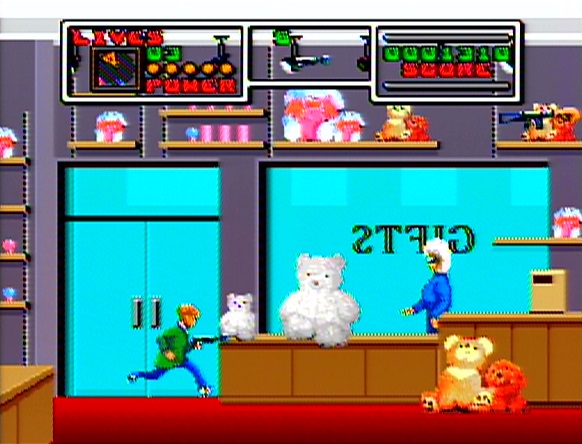
Gimme all the money, granny, or the teddy bear gets it!

As for the gameplay, Kevin's running and jumping mechanics are fine. However, enemy placement is fairly terrible, you'll often have no weapons with which to deal with them, and you'll rarely have any idea of what you're supposed to be doing. For instance, the game's first boss, the Plaza Hotel first-floor elevator, requires you to hit the up button on the elevator five times as living briefcases and I think couches dive toward you. Get up to the next floor, and you have to discern that once you get off the elevator, you've got to go down the hallway and enter and exit every room until you get to the end, then turn around, go back to the elevator, and hit the elevator button again.
 
Totally forgot there were apparently murderous chefs in the film, and now they are my favorite characters

After facing smaller minion chefs, you'll eventually get to the level boss, who is, inexplicably, a large, nearly shirtless master chef, who is only vulnerable to your slide move, utilized by quickly tapping "down" while you're walking. Get through all of that insanity, make it to Central Park, die, get a game over, and you've got to start all over...from the opening Plaza Hotel screen. This game has no passwords or continues. Thankfully, you can earn extra lives by picking up pizza slices (make a whole pizza and you get an extra life), but unthankfully, the unwieldy level design ensures you'll die very often. The game is nowhere near fun enough to warrant trying over and over again, either. It's not even fun enough to warrant trying a few times.
 
Just kill me, guys, I don't want to play anymore

Home Alone 2 for the SNES is the type of game you would have only played through because it was your only option, you had a lot of time to play, and nothing else to do. In today's world, even with astronomical inflation compared to 1992, you can choose from thousands of indie or classic games on a digital platform that cost less than ten bucks and are massively more fun than Home Alone 2. In 1992, Home Alone 2 was $70 from Toys 'R Us and probably the only game you'd have continuous access to for months if you bought or were given it. Then again, you actually owned a game back then, even if it was a piece of crap. Stalemate, 1992/2022. Either way, there had to have been a better way to adapt Home Alone 2: Lost In New York for the SNES.

Yeah, you were. Also, happy 30th Anniversary, Home Alone 2: Lost in New York!


Graphics: 6.0/10.0

Sound: 5.0/10.0

Gameplay: 3.0/10.0

Lasting Value: 2.0/10.0


Overall: 3.6/10.0


Wednesday, December 22, 2021

Batman Returns 16-Bit Showdown


Almost every major blockbuster in the early 90's received a video game adaptation. Even Domino's and Seven Up's mascots received their own video games. If the Noid got his own game, there's no way the hype machine behind Batman Returns was going to let that 1992 smash hit pass through without an adaptation...or seven. Batman Returns is a seminal film for me--at eleven years old, I fell into the film's prime demographic, and I love it to this day. With a protagonist like Batman, major villains like Penguin and Catwoman, and a clearly designed group of underlings in the red triangle circus gang, a 16-bit video game version of Batman Returns essentially designs itself. Developers just needed to put Batman on Gotham's icy streets and let him punch and kick his way through an army of circus freaks, while periodically battling with the two major foes. Toss in some Christmas trees and giant presents in the background for good measure and viola: Batman Returns game. That's just what the three 16-bit adaptations of Batman Returns do...to varying degrees of success.


Batman Returns, Sega Genesis, December 29, 1992

Sega's Malibu-developed Batman Returns game was first to market. The game is a side-scrolling action-platformer, like many movie game adaptations from the era. The speed at which the game came to market betrays Sega's "that's good enough, let's hurry up and get this thing on the shelves" approach, taken with several of their adaptations at the time. This game was clearly not play-tested enough to make sure it was actually fun, though, and...it's not very fun. The absolute first moment of the Sega Genesis Batman Returns asks the player to take a blind jump from the top of the building. You can actually die during this moment, and it's nowhere close to the only blind jump Batman Returns for the Sega Genesis makes the player take. The controls aren't great, either. You've got one button for special items, one for jumping, and one for punching/kicking. You'll also have to use the grappling hook at times (using the jump button and directional pad), but unfortunately, the grappling hook is only even fairly reliable when you're standing still, let alone trying to swing around. You've also got to solve environmental puzzles at times, often on the fly, with death often nigh. With all that in mind, this game is alarmingly difficult. However, it does not earn that difficulty. Beloved legendarily difficult games are generally beloved because the control systems for those games are tight and reliable. You aren't dying because of flaws in those games, only because of your own lack of skill. Batman Returns for Sega Genesis is not that type of game--it is balls out hard because it is not very good. As for production values, the menu screens and pause screen (where you select what special, limited ammo weapon you want to use, i.e. batarang, etc.) look fine. The actual, in-game graphics are kind of simplistic, but solid. The graphics are certainly a step above 8-bit, but nothing great. Same for the music--you've got that trademark, bass-reliant Genesis sound, but nothing much memorable. I will say, though, that the game does capture a bit of the film's dark, inkwell atmosphere...it just doesn't do very many fun or satisfying things with it. Like most Genesis games, there's no save system (or password system). You can continue when you get a game over, but you have to start all the way at the beginning of that particular stage. Each stage has multiple levels, so if you get a game over during the final (generally unfair) boss on the final level of the stage, get ready to play through the entire stage again...not very fun. A disappointment.

Graphics: 6.0/10
Sound: 6.0/10
Gameplay: 4.5/10
Lasting Value 4.0/10
Overall (Not an Average): 4.8/10.0


Batman Returns, Super Nintendo, April 1993

Storied developing house, Konami, took the reins for the Super Nintendo adaptation of Batman Returns. Konami decided to take their adaptation down the 2D beat 'em up route, ala Streets of Rage and Final Fight. This decision, along with Konami's skill as a developer, and perhaps the extra four months Konami spent on this versus Malibu's Genesis version, results in a pretty special game. In opposition to the Genesis adaptation, the controls here are tight and reliable. Tap a button to punch, tap it rapidly to combo and kick. There's a button to jump. Hit jump again to use the grappling hook--reliably. There's a button to throw the batarang, which does minimal damage, but very briefly stuns foes. There's devastating cowl twist move done by holding two buttons that takes a little health off Batman's meter if it connects. There's even the classic beat 'em up "kill everyone on screen" special item. In some games, that item, which you only get so many of, is utilized by just pushing one button, resulting in the player often accidentally unleashing it. Konami solves that problem by having the player hold down the shoulder buttons (which also cause Batman to block), then push another button--a simple solution that helps the player avoid accidentally using the attack. Of course, with side-scrolling 2D beat 'em ups, the player can move up and down in the field of play, as well as left and right. There are no control issues there. However, this game doesn't just stick to the basics. There are bunch of cool little touches. Of course, if you get close to an enemy, you'll grab them and can slam them into the ground or other enemies, but here, if two enemies approach you from opposite sides at the same moment, you can grab them simultaneously and bash their heads together. If you grab an enemy and are standing near a window, you can slam them into it and shatter it--same goes for park benches or other breakable surfaces. Each level has a boss from the film at the end, including that organ-grinder with a monkey and a machine gun. There's even an awesome Mode 7 (faux 3D, scaling sprite) Batmobile stage that looks and plays great. The graphics as a whole here are beautiful, highly detailed, with large, well-animated sprites, and great backgrounds, and it all runs smoothly with no slowdown. The music is mainly 16-bit interpretations of the score from the film, and it sounds great. The Sega Genesis version doesn't have anything like that. This Super Nintendo adaptation simply crushes the Genesis one in both production value and gameplay. That's not to say it's perfect, though. Sometimes the action does grow a little stale. You'll be in the same area wanting to move on, and enemies will just keep flooding in. The length is also at that awkward 45-60 minute mark, where there are no passwords or saves available, and you've simply got to dedicate that big of a chunk, minimum, to get through. You can toggle the difficulty level and number of lives available from the option screen, and each difficulty level feels well-balanced and appropriate. The more I played, the better I got--Catwoman kicked my butt the first few encounters, but after a number of showdowns, I was wiping the floor with her. Overall, Batman Returns for the Super Nintendo isn't just a good adaptation of the film, but one of the better film adaptations of the 16-bit era.

Graphics: 8.5/10
Sound: 8.0/10
Gameplay: 8.0/10
Lasting Value: 7.8/10
Overall (Not an Average): 8.0/10.0


Batman Returns, Sega CD, May 1993

The 1993 Sega CD port of the Genesis' Batman Returns game proved to be the film's final 16-bit adaptation. Sega CD ports of Genesis games were often derided for simply being the same game with a slapped on Redbook soundtrack. Malibu's Batman Returns port received some attention for essentially being that, while adding an entirely new element: sprite-scaling, faux 3D driving. The levels and controls are exactly the same as the Genesis game, but now there are driving levels between each stage. These play and look similarly to the Super Nintendo driving stage, except the controls aren't as good. You've got to hold down the B-button, while pushing the A button to fire discs out, and press C to fire missiles, while using the directional pad for horizontal direction/to ram into foes. The driving stages are timed, and failing to destroy all enemies before the timer runs out results in death, so you've got to constantly hold down the accelerator while firing...meaning you've got to put your hands into some arthritis-inviting positions. I did not enjoy this aspect of the game. It's remarkable that Konami nailed the single driving segment in their game, which could have just been a throwaway stage, but Malibu made driving half of their game, and it doesn't quite work. The driving stages here don't even look as good as the one in the SNES game. The Sega CD Batman Returns' updated soundtrack, while of a much higher sample quality than the other two 16-bit adaptations, only consists of a few pieces recycled over and over again throughout the game, which are seldom interesting. The game's graphics as a whole, though, do look a little bit sharper than they did on the Genesis, but unfortunately, the gameplay is exactly the same--not fun. But hey, there are some new animated cutscenes that look...adequate. Overall, this Sega CD version of Batman Returns is only marginally better than the Genesis one. The driving stages are tedious, and when added to the already tedious action-platforming, just make the game even more tedious. Beating this game in one sitting--which is the only way to beat it since you can't save or use passwords--will take so long, you'll need the patience of a saint, and the masochist nature of a Cleveland Browns fan. This should have been so much better.

Graphics: 6.2/10
Sound: 6.0/10
Gameplay: 4.8/10
Lasting Value: 4.2/10
Overall (Not an Average): 5.2/10.0


I did one of these showdowns for Jurassic Park a while ago and have to admit, I had a bit more fun doing that one because 2/3 of the games weren't awful. Batman Returns for the Super Nintendo is the only 16-bit adaptation of that film that's worth playing. The other two have attractive boxes and that's about it. An objective ranking here is easy, with far more distance between one and two than there is two and three.
Merry Christmas, and goodwill toward men...and women.

1. Batman Returns (Super Nintendo, 1993)
2. Batman Returns (Sega CD, 1993)
3. Batman Returns (Sega Genesis, 1992)