Showing posts with label The Games of 1995. Show all posts

Saturday, January 31, 2026

Chrono Trigger

Chrono Trigger 1995 SNES Review Boxart
Developed and released on March 11, 1995 by SquareSoft, Chrono Trigger features timeless, unrivaled RPG gameplay for the Super Nintendo

I sold my Super Nintendo and all my games for a Nintendo 64 in 1997. I love Nintendo 64, but a couple years later, I was badly missing Super Nintendo--it's the greatest console in the history of video games, so of course I was missing it. In 1999, the greatest year in human existence, I discovered console emulation on my computer. I played NES and Game Boy games (I have since refurbished those old consoles of mine), but more than anything, I played SNES games. At some point I remembered liking Super Mario RPG a lot. I figured I should try out another RPG. For some reason, I settled on 1995's Chrono Trigger...and my life has never been the same. The game consistently blew my mind, culminating in a winning fight against the final boss in the game's apocalyptic 1999 setting literally minutes before the clock struck midnight on the millennium, on 12/31/99. I felt like I had just saved the world (hey, Y2K didn't happen!) and beaten the greatest video game ever made. I soon wondered if I would ever play a better game. The next year, I got a new Super Nintendo (I've never sold another console again) and my own physical copy of Chrono Trigger. I've played through it several times since then, but last year, for the game's 30th anniversary and for the first time in a while, a play through felt necessary.

Chrono Trigger 1995 SNES Review Lavos Lair Final Boss
Ladies and gentlemen, let's go back to the beginning

Chrono Trigger 1995 SNES Review Title Screen Square
That's more like it

I'll be frank. Chrono Trigger is still the greatest game ever made. I've played hundreds if not thousands of video games since I first played through Chrono Trigger. Some of them, like Metroid Prime, Resident Evil IV, or Hollow Knight, were so good, I still think about them all the time. Chrono Trigger is better than all of them. Objectively, the only two games in my lifetime that come close are 1991's The Legend of Zelda: A Link to the Past and 1998's The Legend of Zelda: Ocarina of Time. Maybe Ocarina of Time is a Hyrulian hair's width better. But Chrono Trigger is my favorite. Everything about this game is perfect. So perfect it's pointless for me to ramble on about it, so I'll be concise.
 
Chrono Trigger 1995 SNES Review Crono Fights a tank prison
Like Crono versus a tank

Japanese manga artist, Akira Toriyama, designed the characters for Chrono Trigger. Is that good? Toriyama famously designed the characters for Dragon Ball, in addition to countless others. Rest in peace Toriyama. It simply doesn't get any better. Every single character in Chrono Trigger has an iconic design. The main creative team assembled to create Chrono Trigger, including Toriyama, was called the "Dream Team" because of the superhuman collection of talent involved. The term was originally coined for the 1992 USA Olympic Basketball team, which was the greatest collection of professional basketball players ever assembled, and included Michael Jordan. They won every game by an average of 44 points. Chrono Trigger is the video game equivalent of beating every other team by an average of 44 points. 

Chrono Trigger 1995 SNES Review Chrono Trigger Dream Team
I guess Christian Laettner is Magus

Chrono Trigger's iconic characters are animated in a way I can only describe as perfect--Crono's double-swing sword animation might be the greatest, most fist-pumping video game animation ever created. In addition to the characters, environments and magic attacks are archetypal, as in THEY ARE the archetype. There are graphical elements I love to see in a Super Nintendo game here, done as  well as they ever were. One is waterfalls. Chrono Trigger features several, and they are immaculate--some even contain prismatic rainbows. The second is the background when the player has reached a high place. Chrono Trigger features several of these. One, containing many far off mountains, shrouded in mist, is so atmospheric, it has stuck with and stimulated my imagination ever since I first laid eyes on it. Everything runs smoothly. This might be the best looking game on the console.

 
Chrono Trigger 1995 SNES Review Denadaro Mountains Misty Mountains View Spot
The mountains
Chrono Trigger 1995 SNES Review Ocean View Cape 12,000 BC
The sea
Chrono Trigger 1995 SNES Review Denadaro Mountains Waterfalls
The waterfalls. Hey, wake up!
Chrono Trigger 1995 SNES Review Rain Storm Hunting Grounds 65 million BC 65,000,000 BC
The rain. The brooding.
Chrono Trigger 1995 SNES Review Hunting Grounds Chrono Marle Magus
The jungles. Jungles are an underrated element in the Super Nintendo's arsenal.

Yasunori Mitsuda and Nobuo Uematsu are generally considered two of the greatest video game soundtrack composers of all time. They composed the soundtrack for Chrono Trigger together. The music here is beautiful, atmospheric, iconic, endlessly memorable. The game's sound design, from every sword shink to fiery magic attack, coupled with the music, is perfect. It doesn't get any better than this. Mitsuda's work on 1999's Chrono Cross, the Chrono Trigger sequel, is the only thing that comes close. This soundtrack is the video game equivalent to John Williams' score for the Original Star Wars trilogy. Chrono Trigger's ending theme is the greatest music ever composed for a video game.
 
Chrono Trigger 1995 SNES Review End of Time Party Members Victorian Gaslamp
Once you've been to The End of Time, it is almost impossible to see this image without hearing it. Also, The End of Time, replete with bowler hat-wearing wise man leaning against a Victorian Gaslamp, is the coolest, most comforting location in a video game, ever.

At the time of its release, some critics accused Chrono Trigger of containing too simplistic of a story. I was then greatly confused when I played the game and experienced an incredible, timeless story. I soon realized that those complaining wanted a convoluted, overly dense story that would confuse and bore the average person. There are plenty of RPG's with stories like that, and thankfully, Chrono Trigger is not one of them. The tale begins simply enough. A brave, noble, yet quiet teenager, Crono, meets his inventor friend, Lucca, at the town's Millennial Fair (it is 1000 AD). They accidentally stumble onto time travel, along with the Kingdom's princess, who has visited the fair in disguise so she won't be recognized. From there, the trio accidentally discover that a malignant alien being destroys most of the Earth 1000 years later, and they resolve to stop it. During their time-travelling journey, they make new allies and enemies. The story grows more complex, shocks, surprises, but is never convoluted or confusing. It's awesome. There are HUGE, brave, shocking twists and turns in the story that few if any games have attempted before or since. The plot becomes surprisingly heartfelt. Crono, as the virtuous, but silent protagonist, is the kind of everyman with which any player that's not a sociopath can easily identify. The game's eventual seven party members, many from different time periods, each have their own fully fleshed out story, and all of those stories are awesome. This game is so awesome.
 
Chrono Trigger 1995 SNES Review Party Member Screen Who'll You Replace? Crono Marle Frog Lucca Robo Ayla Magus
I like every possible Chrono Trigger party combination and switch it up throughout the game, but out of sentimentality's sake, I beat the final boss with Crono, Marle, and Lucca this time

Of course, when it comes to video games, even the story is an aesthetic matter. How does the game play? Have you been reading the review up to this point? Perfectly! In the 90s, across the NES, SNES, and PS1, SquareSoft were known as the masters of the RPG, and Chrono Trigger is their masterwork. RPG's leading up to (and many after) Chrono Trigger feature something called "random battles," where the player will be traversing the game world, visually free of enemies, and after every few seconds of moving around, will suddenly be pulled into a battle screen where enemies must be fought. It's tough to enjoy exploration when you don't know whether or not a game is going to suddenly thrust you into battle at any moment, without any warning. Chrono Trigger eliminates this by featuring its enemies onscreen, so that the player can see them before initiating a battle. This not only greatly increases Chrono Trigger's immersion factor, but makes journeying throughout the game more fun. It doesn't hurt that the controls are pitch perfect, as well!
 
Chrono Trigger 1995 SNES Review Crono's House World Map 1,000 AD
Also, the world map is battle free!

As to the game's battles, they are fine-tuned to perfection. At first, each character has their normal physical attack with their weapon, and better weapons are found throughout the game. Eventually, special moves, and later, elemental magic is learned by most characters. Like in most RPG's, winning fights brings experience points that go toward leveling up character stats. However, characters who fight together in Chrono Trigger also gain a special kind of experience point that eventually goes toward that duo or trio learning combos together. There are dual combos, and late in the game, devastating triple combos that are incredibly fun to earn, and these incentivize using different character combinations.
 
Chrono Trigger 1995 SNES Review Delta Force Crono Marle Lucca Triple Tech
Uh...maybe a triple tech was overkill here

Fights even transcend turn-based to a degree, as each character has a meter that must filled before an attack is possible. Different armors and accessories, as well as pickups found throughout Chrono Trigger's world can not only block enemy-inflicted status ailments, but increase the speed at which a character's meter fills. Max out a character's speed, and that given character will be getting in multiple hits to an enemy's one. The game also features many boss battles. These epic fights are strategic, as sometimes physical or magical attacks don't work on that particular enemy, or the boss may be more susceptible to a given move. Even the combination of characters used at a given time can be strategic. Just tapping buttons in this game's highly satisfying boss battles will not work. Thankfully, due to the elimination of random battles, even fighting low level enemies remains fun, and the game, unlike many RPG's, does not force grinding to increase playtime. Plus, the awesome soundtrack is backing all of it. Chrono Trigger is a perfect 25-30 hour adventure without tedious, repetitious fights.
 
Chrono Trigger 1995 SNES Review 2300 AD World Map Epoch
This is what the REAL WORLD would look like right now if I hadn't beaten Chrono Trigger before the clock struck midnight on 12/31/99
Chrono Trigger 1995 SNES Review Crater Meat Eater 2300 AD
I should also mention, I was scared Y2K would happen and take out technology before I beat Chrono Trigger! I was literally working against the clock!

There is also plenty of extra content here. The world is large, and the player gets to explore it through many time periods. At a certain point, the player can set the party to any chosen three character configuration out of the seven party members at any moment (outside of the middle of the fight). Late in the game, travelling through space and time becomes much easier for a very awesome reason. There are also tons of discoverable items that make defeating the game's final boss easier. These items require the player to take on the game's numerous, yet not overwhelming side quests. There's so much fun to be had here, and when the game is beaten, the player unlocks the revolutionary "New Game +" mode, where the player can venture back through the game from the start with the character levels and much (but not all) of the weapons and armor with which the game was ended. While the game's actual final ending is as satisfying as it gets, Chrono Trigger features a dozen unlockable endings for the New Game + player who tackles the final boss at different points in the game (that boss is nearly always accessible!). There's the perfect amount of extra content here to add to an already perfect game. 
I've got nothing else to say. Video games simply do not get better than Chrono Trigger for the SNES. 
If you haven't yet played it, now's the time!
 
Chrono Trigger 1995 SNES Review Time Travel Screen
You don't even have to time travel! Just play it somehow!


Graphics: 10.0/10.0

Sound: 10.0/10.0

Gameplay: 10.0/10.0

Lasting Value: 10.0/10.0


Overall: 10.0/10.0


Wednesday, October 20, 2021

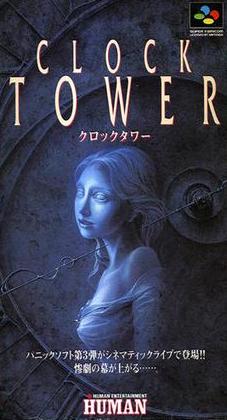
Clock Tower (English Translation)

Released in Japan on September 14, 1995 for the Super Nintendo by Human Entertainment, the 2D, side-scrolling Clock Tower is one of the first survival horror video games.

I don't remember the first time I saw screenshots of Clock Tower, but it was long after the Super Nintendo's heyday--after all, the influential game never came to the good ole U.S. of A. In fact, Clock Tower was never released anywhere outside of Japan. Pictures of the game revealed great, atmospheric graphics. Later superlatives praised Clock Tower for pioneering the survival horror genre popularized by games like Resident Evil, but still, I figured I'd never get a chance to play it.
 
Human Clock Tower?

Well, in the past few years, video game reproduction carts may have oversaturated the market with a bunch of cheap fakes, but they've also allowed players to experience once exorbitantly expensive and rare titles, as well as English translations of once Japanese-only games. With that said, just in time for Spooky Season 2021, I've happened upon and played through a cheap, English-translated copy of Clock Tower.
 
The kind of place where they speak English. "Nice" is relative.

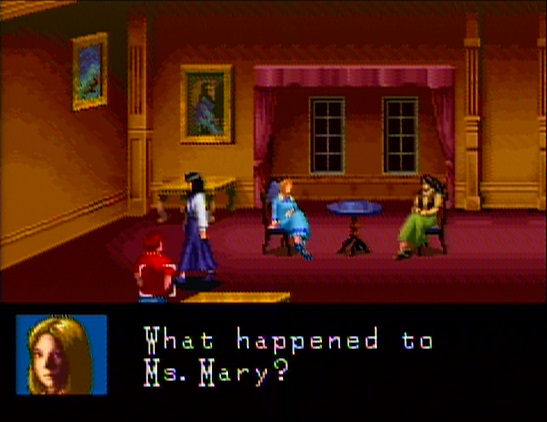
After playing through, I can say that this game definitely looks as good as advertised. You're introduced to your character and the setting through a cutscene composed of stills and text. You plays as Jennifer, a teen orphan being relocated to a remote mansion with several other girls. As the girls arrive at the mansion, the guide suddenly vanishes into the house's dark, huge, and scary halls. Jennifer decides to start wandering around...and that's when the murder begins.
 
She was a bit too contrary

I recently watched Dario Argento's Suspiria, and the style and influence from that film are apparent here. A girl is wandering around a spooky old mansion, the occult might just be involved, and there's not really any depth beyond that. Clock Tower even includes the Suspiria sequence where someone gets shoved to their death through a stained-glass ceiling.
 
Clock Tower is Argento-esque, but with a big pair of scissors

Rooms are highly detailed, atmospheric, and somewhat interactive. As far as music, there's not much, with most of the game being scored by ambient sounds and prolonged, creepy silences. However, the soundtrack is sufficiently suspenseful when it does creep up.

Scissor Dance, all the kids are doing it!

As Jennifer, you wander through the randomly generated mansion, picking up and using items. You look for keys to unlock rooms, solve rudimentary puzzles (i.e., this wall looks cracked, maybe I can smash a hole through it with this rock I found), and try to avoid a psychotic, scissor-wielding, adolescent mansion resident who sometimes pops out of nowhere. The scissors are...quite large. Every now and then during your mansion search, you happen upon your fellow orphans' corpses. Sometimes, you look into an evil mirror and die of terror. Speaking of terror, your character's anxiety often comes into play. If you've constantly been holding down the RUN button (which you'll frequently do because of how slowly Jennifer walks) and been getting freaked out by scissor kid, you're his easy prey. If not, you might just be able to fight him off and run away... 
And that's it: you traverse the mansion halls and rooms, trying to gain access to more and more areas, which unlock more turns in the story, until the end.

Some of those story turns are surprisingly grisly, though sadly, not surprisingly grizzly

So the atmosphere here is top notch for a 16-bit game, and the bones of survival horror are here. Unfortunately, there's not a lot of meat on those gameplay bones. Yes, Jennifer's digitized animations are stunning, but she walks like a slug crawling up a sun-baked hill. Moving around the house is frustrating enough when nothing is chasing you, let alone when there's a psychotic child bounding behind you with over-sized scissors. The controls are also clunky and unintuitive. Sometimes, picking up and using an object takes an act of congress. Also, your game saves automatically when you die. 
What happens if you die in an inescapable situation where you just happen to be pinned up against the wall by scissor boy? 
Why, you've got to erase that save and start the entire game over from the beginning! 
Granted, you could play through this game in two or three hours if you know exactly what you are doing, but if not, losing two or three hours of putzing around and finally getting close to the finish is maddening.

Metaphor for this game

This is a shame because there's clearly a special game underneath all of this frustration. The production values, despite the game's reportedly small development team, are excellent, but it appears they've come at the expense of the gameplay. However, if you can work through these frustrations, Clock Tower shows a striking attention to detail, with multiple story paths and endings--I just wish more effort had gone toward making the game fun.
 
Wait, this one's better


Graphics: 8.5/10.0

Sound: 7.0/10.0

Gameplay: 5.5/10.0

Lasting Value: 4.0/10.0


Overall: 6.0/10.0


Thursday, July 11, 2019

Warlock

Released on May 26, 1995 by LJN for the Super Nintendo, Warlock is a side-scrolling action-platformer adaptation of the sequel to the film of the same name.
The opening ten-second sequence of Warlock for the SNES is one of the most stunning I have ever seen. You begin in a field in front of an English cottage, wind blowing through the trees, butterflies fluttering overhead, birds flying to and fro, your coat billowing in the wind. Your dog prances around the grass as you run through this grassy dream, and into a nightmare of an absolutely horrible video game.
Just don't play past the first ten seconds, and you'll be fine!
LJN is known for having made some horrible video games, particularly horrible video game adaptations of films and TV shows. Warlock is particularly horrible, sharing little in common with the film it is supposedly based upon. Indeed, the only positive elements that came from me playing Warlock, which came six years after film, is experiencing that beautiful first ten seconds, and the fact that I sought out and watched that fun film afterward.
Truthfully, I only bought this game for two reasons: because I saw the first ten seconds on a Youtube long-play, and because it was $3.99 at the Lafayette Play-n-Trade. You can't quite tell how bad Warlock is by watching someone else play it, but you can sure tell by playing it yourself. As soon as you run through that field, and start getting attacked in this side-scrolling action-platformer, it's clear Warlock isn't going to be a classic.
Misfire! Just like this entire game past the first 10 seconds!
You play some kind of wizard, who shoots bolts of electricity or something out of his hands, and has some kind of orb floating over his head that you can kind of use as a weapon, by pushing a button, pointing the D-pad in a direction, and hoping the orb flies that way. Also, when you attack, he stops moving. Ugh.
Enemies come at you non-stop, and you can never seem to get a leg-up on them. Die once, and it's game over. You can die by missing a jump and falling into a pit, or of course by getting hit enough times by the numberless enemies (other wizards, monsters, crazed animals, floating eyeballs that also shoot lightning). Warlock is a bad video game.
Hide! Hide from this game!
Warlock eschews the fun, fish-out-of-water horror/adventure/comedy of the 1989 original film for the rune stones and druid mumbo-jumbo of its sequel. You've got to collect six hidden rune stones from the game's multitude of infinity-long, nondescript levels. When you actually get one of the damn things, you're given a password to get back to that point after you die, so at least there's that. If that doesn't sound very fun, it's because it isn't.
I quickly tired of trying to play this travesty straight, hit google, and found that if you hit "left, left, right, left, right, right, left, right, right, left, left, right" on the d-pad at the opening menu, you get a level select screen, and the option of invincibility. Either invincibility also makes you fly, or I found some rune that gave me the power of flight, I'm not sure, because this stupid game doesn't tell you absolutely anything. So I played the rest of the game invincible, with the ability to fly, and even that didn't make things much better.
If hiding doesn't work, fly away! Fly far, far away!!!
The cheats did allow me to experience the game's dark atmosphere, its only decent quality, though even the atmosphere overstays its welcome and becomes oppressive after a few short minutes.
The graphics themselves bounce around from beautiful pixel works of art to "Did you doodle this with a BIC in your school notebook?" They are just all over the place. The soundtrack is urgent, but after a few minutes of its irritating caterwauling, you'll urgently want to mute your television.
This game is a train-wreck. Thanks a lot, LJN! At least I enjoyed the film!...and the video game's first ten seconds. Man, what a great first ten seconds.

Graphics: 5.0/10.0

Sound: 3.5/10.0

Gameplay: 2.0/10.0

Lasting Value: 1.5/10.0


Overall: 2.5/10.0

Friday, November 23, 2018

Castlevania: Dracula X

Released in North American in September of 1995 for the Super Nintendo by Konami, Castlevania: Dracula X features classic, 2D side-scrolling, monster-killing action in Dracula's castle.

$200. That's how much an original Castlevania: Dracula X cartridge will cost you in today's retrogaming market. Want the box and booklet?  Got $500? For a long time, I didn't even know Dracula X existed. I loved and played the heck out of the 1991 Super Nintendo entry in the Castlevania series, Castlevania IV. That's an all-time favorite of mine. When I found out there was an even newer Castlevania game for the Super Nintendo, I freaked out. With four years of technological advances, would this game be even better than its predecessor? Then I started hearing some strange information: Dracula X was actually only a subpar port of a Japanese only CD game called Rondo of Blood. Konami barely produced any copies of the game. No stores had it. Years later, when online shopping was an option, I found the game, but it was ridiculously overpriced. It has has only gone up in value since. Over time, various versions came out for reasonable prices on various Nintendo consoles' eShops. Still, I wanted to play the game on my Super Nintendo, not on a 3DS. Thankfully, there's another option, and it rhymes with spreeproduction, a legit word I just made up. Time to suit up and grab the Vampire Killer.
Time for some Clinton administration-era gaming
 Dracula X furthers the saga of the Belmont clan, a family that has to battle Dracula and his fiends every hundred years, when he rises from his grave. This time its Richter Belmont, who must rescue his girlfriend, Annette, from Dracula's clutches.
Previous reviews have negatively compared Dracula X to Rondo of Blood. Considering Rondo of Blood is an obscure game from a completely different system that never even made it to America, and that Dracula X only takes a few graphical assets and some music from it, that's not exactly fair. What they should be comparing Dracula X to is the four years older Super Nintendo classic, Castlevania IV. Or I guess they, in this case, me, should try judging Dracula X by its own merits. So here's an experiential review, as in, here is a review of the game as I am playing it.
Okay, so the title screen is not as atmospheric as Castlevania IV...wait, crap, I'm not supposed to compare them. Okay, let's start this thing. The first level is stunning. It takes place in a burning town, and it looks great! Flames dancing into the sky, heat warping the sight of the impressive background architecture.
We didn't start the fire, but I really hope this is Billy Joel's re-animated skeleton, so that I can finally punish him for writing  that terrible song.
The music is uh...an early 90's take on Castlevania's gothic trademarked music. The opening level's music begins with a wah-wah disco guitar sound before settling into a more traditional symphonic mold. The sound quality is great, really pushing the already famously good Super Nintendo sound chip. However, after a few minutes of gameplay, something becomes painfully clear: from a control standpoint, Dracula X is a throwback to the original NES games in the series...which is not a good thing. The first Castlevania game treated jumping like a thing Super Mario Bros. didn't already perfect--once you jump forward, there's no changing your momentum. Castlevania IV remedied this...but Dracula X brings this issue back like it's 1986.
Er...time for some Reagan administration-era gaming?
This is highly exacerbated by the fact that Dracula X loves throwing unseen bats and flying medusa heads at the player. Jump forward across a chasm, and chances are high a bat might fly onto the screen while you are in midair, and knock you backward. Knock you backward? Yes, that's another element Dracula X has inexplicably retrieved from 1986. When something hits Richter, he is knocked backward a couple of feet. If you are standing on, or about to land on a platform, and a stupid, previously unseen bat flies into you, get ready to go toppling over into a bottomless chasm. This is the most common form of death in Dracula X, and it is maddening. IT IS INFURIATING.
Uh, oh, better gaze into this soothing cave photo to calm down.
Okay, I'm better, but now I'm too flustered to keep writing this review as if I'm first playing the game. Let's cut the illusion.
The jump and "knock-back" mechanics in Dracula X are unforgivable. Castlevania IV progressed this series into the 90's, and for the most part, X throws it right back into the soft, gauzy perm of the 80's, replete with gameplay that feels more like trial-and-error memorization than pure skill. Admittedly, those 80's games are fun, but those particular mechanics are absolutely frustrating. Dracula X is fun in the same way, really feeling more than anything like a big dumb, late 80's arcade version of Castlevania, with large character sprites, and extremely simple gameplay. Castlevania IV let its Belmont hero swing from hooks with his whip, and lash out in any direction, while giving the player ultimate control over his jumps. That 1991 game has an air of sophistication that Dracula X never even sniffs. However, my previous statement rings true. Dracula X can only be judged on its own merits: as that of a big, dumb, arcade style Castlevania.
Look, it's big, dumb Dracula.
Like an arcade game, it's only got a limited amount of levels...in this case nine, though two of those are only accessed by taking an alternate path through the game...meaning that in any given playthrough there are only seven levels. Like an arcade game, the difficulty is heightened to lengthen the game (and get more of your quarters!), in this case with the lousy jump mechanics and cheap enemy locations. Even the one element of sophistication the game has, giving the player access to two pretty cool alternate levels in the middle of the game, only makes those levels accessible by crossing a chasm filled with tiny platforms and swarming flying enemies that knock Richter into a pit holding the path to the main stretch of levels.
You don't even want to know what I did to get to this water dragon boss.
The soundtrack mostly foregoes Castelvania IV's complex, gothic atmosphere for a bouncy, more superficial interpretation, just like you would have heard in a late 80's arcade. The game's one step forward for the series, the item crash, feels like an arcade super button as well--it allows the player to take their secondary weapon, a throwing axe, holy water, etc., and use a large chunk of its ammo to perform a massive, screen-filling attack. The graphics are also bold and in-your-face, with the large sprites I previously mentioned, and a simple, attractive design. Even the game's big, generally awesome-looking bosses feel a bit arcade-y.
All that's missing is that annoying stranger kid standing too close to you, trying to give you gameplay tips.
Thankfully, unlike the arcade, you don't have to put quarters in to keep playing when you die. Like Castlevania IV, Castlevania: Dracula X includes a password system. However, even with the heightened difficultly, and branching level paths, which lead to slightly different game endings, experiencing everything Dracula X has to offer isn't going to take even the most average player long. Maybe ten hours total if you take a lot of breaks to put the controller down to make some sandwiches. My overwhelming feeling is that while Castlevania IV is the definitive Castlevania game for the SNES, and a series standout, I'm not sad that Dracula X exists. For all its flaws, it's a unique foray into the Castelvania universe, and I can't say it's one I won't want to take again. I'm just glad that for players like me who want to experience the game on their original Super Nintendo, there are...um*cough*alternative means*cough*...to paying a fang and a leg.
Besides, climbing these steps is good for my calves.


Graphics: 8.5/10.0

Sound: 7.0/10.0

Gameplay: 6.5/10.0

Lasting Value: 5.0/10.0


Overall: 7.0/10.0

Thursday, February 22, 2018

Donkey Kong Country 2: Diddy's Kong Quest

Released on November 20, 1995 by Nintendo, and developed by Rare, Donkey Kong Country 2: Diddy's Kong Quest follows the original with more challenging 2D platforming action.

Donkey Kong Country changed what seemed possible. The Super Nintendo, three-years into its American lifespan, could suddenly pump out 3D graphics and CD-quality sound like your home computer. The Super Nintendo had already given its owners a seemingly infinite amount of awesome games: Super Mario World, The Legend of Zelda: A Link to the Past, Mario Kart, Star Fox, Earthbound, Super Metroid, Final Fantasy VI...the list could go on for pages. Now, what were these new wonders? Would the Super Nintendo continue delivering new joys forever?

It should actually be full of Super Nintendo games!

Actually, yes, it would, though Rare's Donkey Kong Country games serve as a sort of victory lap, featuring some of the greatest graphics and music of the Super Nintendo's original lifespan (Obviously, I only mean"forever" in the sense that, with the amount of incredible Super Nintendo games, a retro-gamer can find joy in the system for an entire lifetime).
A year after Donkey Kong Country's release, Rare returned with the 1995 sequel, Donkey Kong Country 2: Diddy's Kong Quest.  Some people accused the original Donkey Kong Country of having less than stellar gameplay, and of not being challenging enough. Those people are both wrong and crazy, but Rare took their words to heart and created a tighter, more difficult game for the sequel.

Literally everything in this picture can kill you, including the token and bananas, which are just siren's songs.

The first Donkey Kong Country game features 2D platforming action, giving the player control of Donkey and Diddy Kong as they traverse diverse environments, collecting bananas like Mario does coins (100 bananas equals an extra life), among other items, and progressing through levels on world maps in order to reach and defeat a final boss, in that case, K Rool the crocodile. The original features challenging jumps, timing challenges where the player must launch from moving barrel to moving barrel, animal transformations, and boss fights. If you get hit once, you die. Thankfully, the game features a tag-team element, where the player can smash a liberally-scattered DK Barrel, freeing whichever Kong they aren't using. That Kong follows whichever one the player is using, and the player can switch between the Kongs at will. Get hit and your Kong still dies, but you immediately take control of the unused Kong...of course, if you then get hit with that Kong, your life is over, just like when your middle school girlfriend/boyfriend broke up with you for a cheerleader/jock/cheerleader jock.
Every level features a save barrel at the mid-point, and the letters "K," "O," "N," and "G," hidden across the level in order--get all four letters, and the player is rewarded with an extra life.

Then lands on the weird porcupine and dies.

Donkey Kong Country 2 follows, but adds several wrinkles to this formula. The first is that Donkey Kong is out. The first game featured a banana-pilfering K Rool...this one features a Donkey Kong-pilfering K Rool. This time around, Diddy Kong takes center stage with his girlfriend Dixie Kong--I am assuming, no relation--in order to save the titular ape.  I don't like how that previous sentence contained both references to incest and the phrase "titular ape." I really need to clean this blog up.
Like its predecessor, Diddy's Kong Quest features animal enemies that can be vanquished by jumping, or by each Kong's basic attack, in Diddy's case cartwheeling, in Dixie's spinning. Diddy also runs faster and jumps higher than Dixie, but Dixie can use her hair to glide after she jumps. Dixie's gliding is beneficial for not only long jumps, but jumps where precision is more valued. The player will need this precision, because--second wrinkle--with more difficult jumps, and more spikey, lava-coated, stingy, death-bringing objects and enemies to avoid, DKC 2 is indeed more difficult than its predecessor.

Wait, is there anything in this game that doesn't kill you?

Those "touch me and you die" enemies, like bees, can only be avoided, or felled by other means.
For instance, as in the original, Diddy and Dixie (well, Donkey, in the original) can toss barrels they find at enemies, and at select moments, can either ride or turn into an animal helper. There's Rambi the rhino, who can charge and ram through enemies, Enguarde the sword fish, who can swim swiftly and skewer enemies, Bocephus the flying squirrel, who can bite enemies and give them rabies, Squawks the parrot, who can fly and spit Kola nuts at enemies, and Squitter the web-spitting spider, among several others. I made one of those up.
Just like in the first game, using these Kong friends is a blast, particularly the hard-charging Rambi.

That rat's gonna feel it in the morning.

Each level also contains a very-well hidden "DK Coin," and several bonus barrels featuring short challenges, in order for the Kongs to earn bonus coins. These are needed to access the game's final world.
Each of the game's seven worlds feature five + levels, and a respective space for four other, deservedly less-beloved Kong's who Diddy and Dixie can meet for various ends. There's Wrinkly Kong, who can save the player's progress (for a price) and give gameplay tips, Cranky, who gives level secrets (also for a price), Swanky, who charges the Kong's to play a quiz game to earn extra lives, Beatrice Kong, who berates the Kongs for their shockingly subpar skills at karaoke, and Funky, who can fly the player to previously played worlds (yep, that costs, too!). Not all of those are real.
These Kongs must be paid in tokens for their services. These tokens can be collected from all of the game's levels (and they "respawn" every time the player dies, making it not entirely difficult to acquire them).
This leads to the one patch of scabies in Diddy's Kong Quest's fur: at very select moments, the saving system feels a little mean.

I wish I only had one patch of scabies in my fur.

Say you've been struggling to beat one of the game's bosses, because, like Bocephus the flying squirrel, Donkey Kong Country 2 doesn't play around. Finally, you beat that boss and move on to the next world. You only have one life left, and zero tokens (there's none to find in a boss battle). You make it to the next world, but there's no save point in sight (you can only see up to the level you've progressed to). Hands shaking, you fight through this challenging first level, and somehow, miraculously, do not die. However, when you move on to the next level, horror of horrors, one of Wrinkly Kong's Kong Kolleges are nowhere in sight. You can't yet save. You've got to beat another level. Somehow, you make it near the end of this level, and you haven't died once. You even get to the letter "G." Surely, the end is at hand. The level's final jump is incredibly challenging, and yet somehow you make it. Up pops the Kong Kollege. You enter to save your game. That's when you realize it: you only have one token. Wrinkly charges two to save. You cannot save your game. You re-enter the previous level to find a token. You die. Game over. Now you get to start back on the previous world, at the spot before you had beaten the boss. Crap.

I'll juggle for a save!

Donkey Kong Country 2 exists in a strange realm between two very different gaming eras. The first featured games that had to be exceedingly difficult to stretch out gameplay, because technological limitations meant they could neither be lengthly nor saved. The latter, current era, mostly features less challenging, longer games that allow the player to save at any moment. Donkey Kong Country 2 is difficult, fairly long, and makes saving in the earlier portions of each world a challenge. As much as all that dying and starting over at a boss in the previous world is a remnant of the previous era to increase gameplay time, DKC 2 embraces second era game-stretching techniques, as well. If you haven't guessed, that technique is forcing you to find all those DK and bonus coins in order to truly finish the game. You will most likely only undertake this quest at the end of the game, because by then it has become a necessity. All of the save points have been opened by then, the game informs you of which levels still have unfound items, and world-to-world travel is free, making this portion of the game thoroughly modern. While Donkey Kong Country 2 is incredibly fun and features brilliantly designed levels, once the player reaches the latter half of the coin quest, just a bit of fatigue sets in, just like with all of the Youtube-conditioned readers skimming through this right now.

Here, look at the pretty picture.

Thankfully, there are factors to offset this fatigue, namely, that the game looks absolutely incredible, and sounds phenomenal (and in the case of you reading, that the vending machine in the break room has Doritos). The graphics were made by the same Silicon Graphics workstations as the original DKC, but here they are even more highly refined and detailed. For instance, the Kong Letters, once a static item on the screen, are now fully three-dimensional spinning objects. Colors are bright and beautiful, the palette a little more yellow, orange, blue, and purple, than the heavy green, white, and red of the original. Diddy and Dixie are fantastically rendered, as are their animal sidekicks and enemies. The backgrounds are evocative and imaginative, as are environmental details like fog, clouds,wind, rain, lava, and water. However, one thing outshines the game's graphics: David Wise's incredible soundtrack.

"Hot Head Bop" in your head right now, along with your usual thoughts of desperation and loneliness.

Donkey Kong Country 2's music has likely been covered by more artists than any other video game's soundtrack. Wise's high-quality samples and sounds, put to work on his incredible compositions, are a feast for the ears. It's nearly impossible, even years after playing the game, to look at one of the stages and not have its specific music pop into your head. This music is highly atmospheric, percussion heavy, with a strange naturism unique to the DKC game series. "Hot Head Bop," "Stickerbush Symphony,""Forest Interlude," these titles are now legendary, even eclipsing the first DKC's "Aquatic Ambiance." If Donkey Kong Country 2 was an otherwise terrible game, the soundtrack would still make it worth playing.

Glad they let you use Enguarde in this level, instead of Bocephus.

Thankfully, Donkey Kong Country 2 is not a terrible game. It is an excellent, near perfect one, featuring only the minor flaws I described above. Any fan of 2D platforming games who hasn't yet played it should take a deep look at their priorities...gaming priorities, I mean, not like, neglecting your family priorities. Also, you should bring a friend along for the experience (playing the game, not neglecting your family). Like the original, DKC 2 features a two-player cooperative mode, with each player controlling one of the two respective Kongs. The players can tag each other in, or take over the gameplay once the first player has perished. Just like in the first game, this mode is awesome. The whole game is awesome. With the slightly higher production values, the greater challenge in not only collecting more items, but navigating greater obstacles, and the incredible replay value due to all of the above, Donkey Kong Country 2: Diddy's Kong Quest is a can't miss title.

Yes, I'm bragging. No, that game clock doesn't count the 20 extra hours I spent dying.

November 20, 1995 Nintendo/Rare

Graphics: 10.0/10.0

Sound: 10.0/10.0

Gameplay: 9.5/10.0

Lasting Value: 9.5/10.0


Overall: 9.8/10.0